
Fast is a real option.
Reckless isn't the same thing.
You can lose weight quickly. The question nobody selling a 21-day programme wants to answer is what you're losing, and whether it stays off. Here's the honest version — the rate that's actually achievable, why crash approaches stall, and how to hit the fast end of the range without wrecking what's underneath.

How fast is
actually possible.
Roughly 0.5% to 1% of bodyweight per week is the range where weight comes off quickly and the muscle underneath survives. At 200 lb that's one to two pounds a week. At 260 lb it's closer to one and a half to two and a half.
Heavier starting weights can move faster early, and the first week or two almost always shows a bigger drop than the rest — that's water and glycogen leaving, not fat. It feels fantastic and it's the reason so many programmes are sold in two-week blocks.
Two pounds a week is 100 pounds a year.
People chase faster because a week feels slow, not because the arithmetic requires it. Nobody who's actually held that rate for six months has ever complained it wasn't rapid enough.
Why the scale isn't the whole story
Weight is fat, muscle, water, glycogen and gut contents all at once. Two people can drop the same fifteen pounds and end up looking completely different — one leaner and stronger, the other smaller and softer with a lower maintenance intake than they started with.
The scale can't tell you which one you're getting. That's why we don't run programmes off it alone.
Why crash diets
stop working.
Very aggressive deficits work — for a while. Then they reliably do the same four things.
- Muscle goes with the fat. The steeper the deficit, the larger the share of weight that comes from lean tissue. Especially with no resistance training underneath it.
- Maintenance drops. Muscle is metabolically expensive. Lose enough of it and your body needs fewer calories to hold your new weight — so the deficit that was working stops working.
- Adherence collapses. Hunger, fatigue, poor sleep, no training capacity. Nobody white-knuckles that indefinitely, and the plan that ends in week five delivers less than the plan you can hold for six months.
- Regain arrives as fat. Weight that comes back after a crash is overwhelmingly fat, not muscle. Each cycle leaves body composition worse than the last.
This is why people who've "lost the same 30 lb four times" are in worse shape than when they started.
Not because they lack willpower. Because each round took muscle out and put fat back.
The same logic applies whether the deficit came from willpower or from medication — the mechanism doesn't care how you got there. We cover that in detail on keeping muscle on GLP-1 medication.
What medication changes —
and what it doesn't.
A lot of people arriving at this page are already on a GLP-1, or thinking about it. Semaglutide and tirzepatide are approved and prescribed widely, and retatrutide — a triple-receptor compound still in Phase 3 trials — is the one generating most of the noise.
Here's the part worth understanding, because it's the opposite of what most people assume.
These drugs don't break the rate ceiling. They make the deficit easier to hold.
Retatrutide's Phase 2 trial produced a mean weight reduction of 24.2% over 48 weeks at the highest dose — the largest figure the class has produced. Average that across the study and it works out around 0.5% of bodyweight per week. The same range as the top of this page.
What appetite suppression actually removes is the thing that used to end every attempt: hunger. That's genuinely valuable, and it's why these medications work where willpower didn't. But it also removes the brake. People don't choose an aggressive cut — they simply stop feeling like eating, and nobody's watching how far the intake has fallen.
Faster loss raises the stakes rather than lowering them
Every mechanism on this page still applies. A steeper deficit still takes a larger share from lean tissue. Lower muscle mass still lowers your maintenance intake. Regain still arrives as fat. The drug changed how you got into the deficit, not what the deficit does.
And because these compounds produce larger total weight loss, the same proportion of lean tissue represents more absolute muscle gone. A more effective drug increases the need for adequate protein and resistance training — it doesn't reduce it.
We don't prescribe, supply or advise on medication — that's a conversation for your doctor, and retatrutide in particular has not been approved by Health Canada or any other regulator. What we do is build the training and nutrition around whatever route you and your physician settle on. The full breakdown, including the trial body-composition data, is on our page about keeping muscle on GLP-1 medication.
Three things that make
fat loss fast.
None of this is exotic. It's the same short list every time, and it's the execution that separates people who get there in twelve weeks from people who spend two years going nowhere.
A deficit you can actually hold
Aggressive enough to move quickly, moderate enough to keep training hard and sleeping properly. That line is different for every person and it shifts as you get leaner — which is the part a template can't do.
Protein high enough to defend muscle
The single most protective variable in a deficit. It preserves lean tissue, blunts hunger, and costs more energy to digest than carbohydrate or fat. Most people arrive eating roughly half what they need.
Resistance training, not just cardio
Lifting is the signal that tells your body the muscle is needed. Without it, a deficit strips lean tissue as readily as fat. Cardio burns calories; lifting decides what the weight loss is made of.
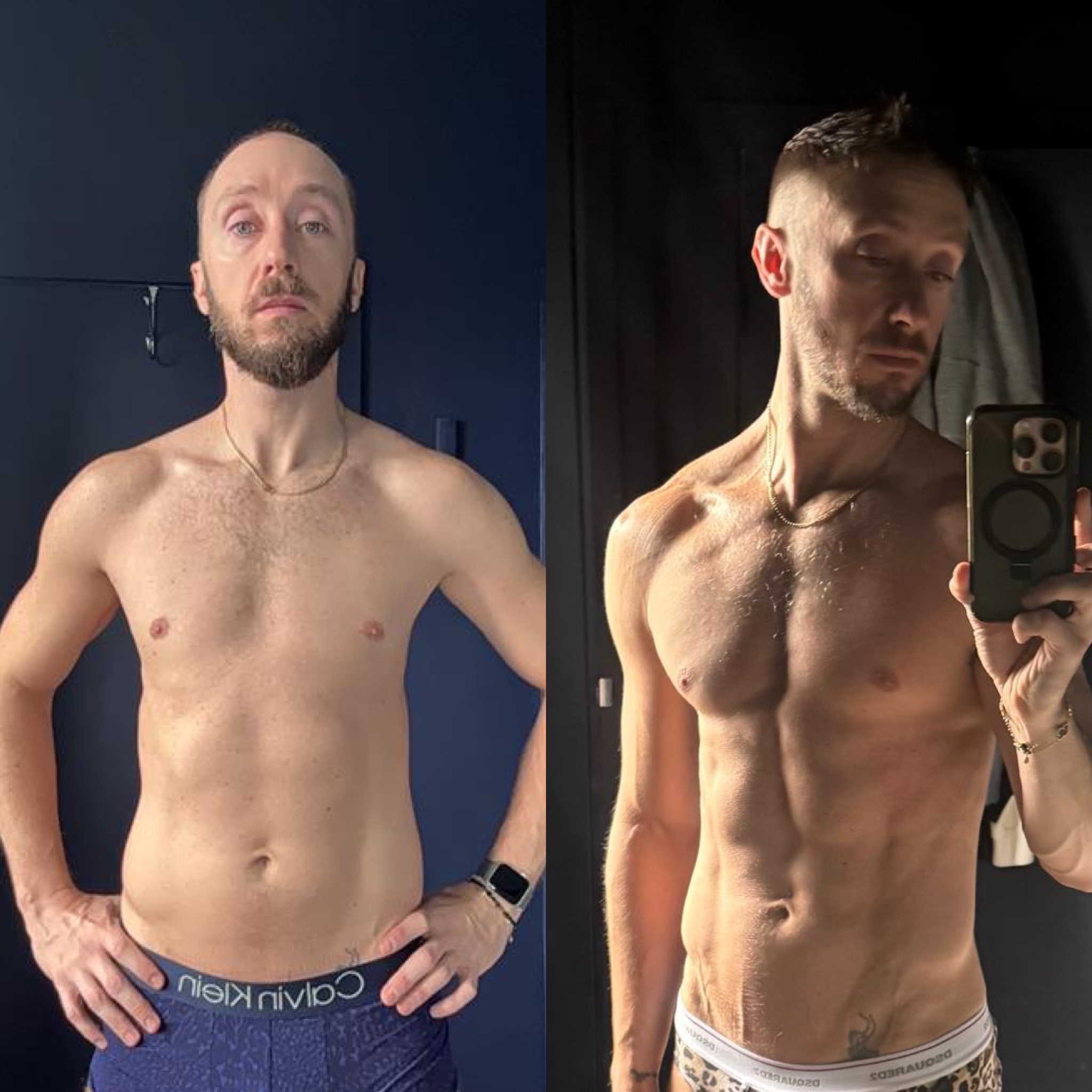
Fat loss is the thing
we do best.
Hammer Fitness is a private, appointment-only personal training gym in Scarborough. Every session is one-on-one. We've coached fat loss since 2012 and it's the largest share of what walks through the door.
Built around you, adjusted weekly
Your deficit, protein target and training block are built from your bodyweight, training history and schedule — then adjusted as the numbers move. When loss stalls we change something specific; we don't tell you to try harder.
Progress measured properly
Scale weight alone can't tell you what you lost. Strength retention is the working proxy: if your lifts hold while bodyweight falls, the muscle is holding. If your lifts fall off, the deficit is too steep and we correct it before it costs you.
A private floor and equipment that earns its place
Appointment-only means no crowds and no waiting. The equipment on our floor is a curated collection of rare imported machines chosen for engineering rather than price. A properly profiled cam matches resistance to the strength curve of the muscle, so a set produces more stimulus for less joint stress — which matters most when recovery capacity is already reduced by a deficit.
The MED Method
The minimum effective dose is the least training that produces the adaptation you want. It's the target because everything beyond it is cost — more fatigue, more recovery debt, more time — bought at a declining rate of return. In a fat-loss phase, where recovery is the constraint, that matters more than it does at any other time.
It's the framework behind every programme we write, and it's why our clients generally train less than they expect to, not more.
Who's actually coaching you
Amer Kamra founded Hammer Fitness in 2012, holds an IFBB pro card, and completed a Masters in Resistance Training under Tom Purvis. Every coach on the team works to the same method and receives ongoing instruction directly from him — you can meet them on our coaches page. You work with the same coach each session. No rotating staff, no app handing you a template.
Who this suits
- People who've lost the same weight more than once. Usually the problem wasn't effort — it was that nothing protected the muscle, so each round left maintenance lower.
- Anyone with a real deadline. A wedding, a holiday, a photo. We'll push toward the top of the sustainable range and manage it, rather than promising something the arithmetic won't support.
- Clients on or considering weight-loss medication who want the training half handled properly.
- Busy professionals. The MED framing exists precisely because most people don't have unlimited hours, and the sessions are booked so nothing is wasted queuing.
You can see the range of starting points in our transformations, and what clients say in the reviews — over 1,200 five-star ratings on Google. If you want the detail on how the coaching itself runs, that's on our personal training page, and the thinking behind it is set out in our philosophy.
Common questions.
How fast can I actually lose weight?
Roughly 0.5% to 1% of bodyweight per week is the range where loss is quick and muscle survives. At 200 lb that's about one to two pounds weekly. Expect a larger drop in the first week or two — that's water and glycogen, not fat, and it doesn't continue at that rate.
Can I lose weight faster than that?
Physically yes, and the cost is predictable: a larger share of lean tissue, a lower maintenance intake afterwards, and a much higher chance of regain. If you have a hard deadline we'll push toward the top of the range and manage it properly. We won't pretend a steeper deficit is free.
Is rapid weight loss safe?
Within a sensible rate, with adequate protein and resistance training, yes. Very low calorie approaches are a different matter — they carry real risks including significant muscle loss, gallstones, nutrient deficiencies and severe fatigue, and belong under medical supervision rather than a gym programme. We don't run them.
Do I need to do a lot of cardio?
Less than you'd think. Cardio is a tool for adding to the deficit, but the deficit itself comes mostly from intake, and resistance training is what determines whether the weight you lose is fat. Piling on cardio while eating very little is how people end up smaller but softer.
Will I put it back on?
That's decided by what you keep, not what you lost. Muscle retained through the deficit supports a higher maintenance intake, so holding your result takes less effort. Weight lost through restriction alone leaves you defending a lower weight on fewer calories — which is why that version usually doesn't hold.
How long before I see it?
Most people notice a change in how clothes fit within three to four weeks. Visible changes other people comment on tend to land around eight to twelve weeks. Strength and energy usually improve before the mirror does, which is worth knowing so you don't quit at week three.
Can a GLP-1 make me lose weight faster?
It makes a deficit far easier to hold, which for many people is the difference between a plan that works and one that doesn't. It doesn't lift the ceiling on how fast fat can safely come off. Retatrutide's Phase 2 trial, the largest result the class has produced, averaged roughly 0.5% of bodyweight per week over 48 weeks — inside the same range as everything else on this page.
Do you coach clients who are on weight-loss medication?
Yes, and a growing number. We don't prescribe, supply or advise on medication — that belongs with your doctor. We build the training and nutrition around it so the weight you lose is the weight you meant to lose. More detail on keeping muscle on GLP-1 medication.
Is retatrutide available?
No. Retatrutide has not been approved by Health Canada, the FDA or any other regulator, and remains in Phase 3 trials. There is no prescribing pathway for it. We don't advise on sourcing or using unapproved compounds.
What does it cost?
Programmes are built individually, so it depends on session frequency and what you're working toward. The consultation is free and there's no obligation — get in touch and we'll give you a straight number.
Let's find your actual rate.
Tell us where you're starting and what you're working toward. We'll call you to arrange a free consultation and give you a realistic timeline rather than a sales pitch.
This page is general educational information about training and nutrition, not medical advice. Rates of weight loss vary between individuals and no specific result is guaranteed. If you have an existing medical condition, are taking medication, or are considering a very low calorie approach, speak with your doctor before starting.